Showing posts with label librarian recommendation. Show all posts

Monday, December 6, 2010

Sex, Drugs, and Cocoa Puffs by Chuck Klosterman


Call Number: Stacks E169.12 .K56 2004
Recommended by: Rus Springer


In this collection of essays Chuck Klosterman explores popular culture as experienced by people coming of age in the 1980s and 1990s. For the rest of us, he gives insight into the ways in which who we are in reality is often only a reflection of who we are in popular culture.

Along the way he touches upon how, ultimately, no one is able to find real love because of John Cusack; how the Real World changed from being a sample of the youth of America to unintentionally creating the youth of America; the realization that Pamela Anderson, like Marilyn Monroe before her, is the sex symbol for our time largely because times change; that the 1980s rivalry between the Celtics and the Lakers represents not just race in American but “absolutely everything” about America; the fact that Saved by the Bell is an explanation of all things Generation X; and the relationships between the apocalyptic, Christian theology of the Left Behind series and NFL football and “America’s insipid Oprah Culture”—plus much more.

His irreverent and uniquely skewed take on such things may produce a chuckle but, ultimately, he delivers the ideal in criticism: it is less about a specific artifact and more about the culture itself.

Tuesday, November 30, 2010

Wolves Eat Dogs [sound recording] by Martin Cruz Smith


Media/Audio Computer Disk PS3569.M5377 W65 2005
Recommended by: Susan Kraat, Librarian

Martin Cruz Smith’s Wolves Eat Dogs is a very good listen,
even as it is a sobering account of life in post-Chernobyl
Chernobyl, the Zone of Exclusion in the Ukraine commonly
referred to simply as the “Zone.” Detective Arkady Renko
(remember Gorky Park?) travels from Moscow to the Ukraine,
to solve a crime involving Russian gangsters and
radioactive chemicals. Smith describes the criminal world
of Moscow, the new Russian capitalism, and the regional
apocalypse in the Ukraine that remains since the 1986
nuclear meltdown. The despair is tangible and
unrelenting, bearable because of the author’s compelling
prose and bleak sense of humor. Ron McLarty reads with
exactly the right tone and has a clever ear for dialect.

Wednesday, November 24, 2010

Magic Land of Toys by Alberto Manguel


Recommended by: Stephan J. Macaluso, Librarian
Oversize NK9509.5.F8 P376 2006

Manguel is a prolific author, translator and anthologist whose interests range from art appreciation to classics to mystery. Magic Land of Toys, however, is really a picture book. Manguel collaborates with photographer Michel Pintado, set designer Jean Haas and (the real star of the show) the toy collection of the Paris Musee des Arts Decoratifs to present a series of vignettes that conjure our childhood playrooms.

The cinematically-rendered images of the toys, posed --sometimes suggestively-- in mid-action, provoke us to reflect on play, collectables, childhood and age-old questions like Are toys really alive? and What do our toys do when we’re not around? While the scenes speak vivdly by themselves, Manguel’s insightful texts comment on memory, identity, lost toys, and the importance of imagination. This is a splendid source of introspection and nostalgia. It also makes a great game of I Spy.

Wednesday, July 28, 2010

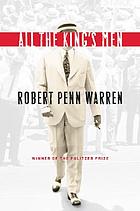
All the King's Men by Robert Penn Warren


Recommended by: Susan Kraat, Librarian
Call Number: PS3545.A748 A4 1963

I first read All the King’s Men, while vacationing in Maine this summer. No, I had never been assigned to read it, or picked it up until now. In preparation for our trip, I noticed that more than one “best novel” list included Robert Penn Warren’s classic tale of southern politics, based upon Huey Long, former governor (and senator) of Louisiana. It is a vivid story of ambition, blackmail, deception, hubris, and murder, told by a narrator who attempts to distance himself from the dirty nature of his work, as well as from his past. The poetic language draws you into a world of southern politics and competing ideologies from the first page, and never disappoints. This is a story about a man of humble origins who rises to power, uses his oratory skills and his influence to commit dark deeds in the name of idealism, and who must suffer for his sins in the end. It tells of the struggle between the old South and the new South, and lets us know that politics remains a dirty business. But after the turmoil and bloodshed there is still a bit of hope at the end. Penn Warren quotes Dante at the beginning of the book: “Mentre che la speranza ha fior del verde” I did not look for the translation until the end and I am glad that I waited.

Friday, July 9, 2010

I'll sleep When I'm Dead: the Dirty Life and Times of Warren Zevon


Recommended by: Stephan J. Macaluso, Librarian
Stacks ML420.Z475 Z58 2008

Poetry, joy and sarcasm flowed from Warren Zevon’s imagination. Zevon was a gifted and intelligent songwriter and performer whose depth goes far beyond “Werewolves of London.” He was admired by David Letterman, Linda Ronstadt and Hunter S. Thompson. Zevon had profound demons: substance abuse, womanizing, OCD and odd, paralyzing superstitions. Even as a recovering alcoholic, he rode an uneasy rollercoaster of family issues, touring, and middle-list record sales; he died of cancer in 2003, when many believe he was at the height of his powers. Zevon’s life is uniquely memorialized here by his former wife and longtime friend, Crystal Zevon. She lets Warren's story unfold through interviews and statements from his collaborators and friends (Bruce Springsteen, Stephen King, Dave Barry and Billy Bob Thornton, to name a few), his family and through Warren’s diaries. The result is an insightful and riveting picture of one of our greatest songwriters. Be sure to listen to Zevon’s impressive output while you read!

Friday, June 5, 2009

Magnetic appeal: MRI and the Myth of Transparency by Kelly A. Joyce


Recommended by: Stephan J. Macaluso, Librarian
Call Number: Stacks RC78.7.N83 J69 2008


Ever wonder why Magnetic Resonance Imaging (MRI) is today’s “go-to” diagnostic procedure? Why radiologists prefer black & white MRI images to color? Or why they prefer to look at the images instead of the equally revealing numerical data created by the same machines? Kelly’s investigation into MRI technologies uncover a number of myths about whether an MRI is always useful or required. Like the one perpetuated by movies and TV dramas, where MRI can see exactly what's wrong with patients, and even fix what ails them. Our own highly visual culture is also to blame for this misperception. And insurance companies, MRI and drug manufacturers, the legal system and even physicians themselves are also complicit in the overuse and over reliance on MRI technology. A very readable current history of MRI that may change the way you see the medical profession.

Monday, December 1, 2008

Schuyler’s Monster: A Father’s Journey with His Wordless Daughter by Robert Rummel-Hudson


Recommended by: Stephan J. Macaluso, Librarian
Call Number: Stacks RJ506.D47 H83 2008

Robert and Julie’s daughter, Schuyler, was born with a malformation of the folds of the brain. It robs Schuyler of speech and fine motor control. Robert refers to her condition as a Monster: it is a very rare disease with dire consequences and a frightening name; it lay in wait from before Schuyler’s birth, only to manifest itself at age three. Schuyler, Robert and Julie endured years of testing before her diagnosis--Schuyler was originally thought to be autistic. After much research, consultations with leading experts and a series of unforgettably enervating meetings with school officials, Schuyler began special classes and was given an electronic speech device, paid for in part by readers of Robert’s blog. This book is as much about a father’s unconditional love for his daughter as it is about a child with a complicated disease. Robert is a fine storyteller and this memoir is an honest, inspiring and very real look at fatherhood, coping, and a family’s resilience.

Wednesday, October 1, 2008

What is the What : The Autobiography of Valentino Achak Deng by Dave Eggers

Recommended by: Megan Coder, Librarian
Call Number: Stacks PS3605.G48 W43 2006

What is the What
is a heartbreaking and heartwarming story about Valentino Achak Deng, a Lost Boy of Sudan. Dave Eggers tells his story through fact and some fictionalized accounts. It’s amazing to read all that Valentino went through during his flight from Sudan to escape the civil war where over two million people died. He had to leave his family without ever seeing them again, watch many of his dear friends die on the treks to Ethiopia and Kenya, endure countless days without food or water, and tolerate many trials and tribulations at various refugee camps. However, Valentino is a hopeful soul and though his tale is full of much sorrow What is the What is an inspirational read because of his positive attitude and resilience.

Thursday, September 25, 2008

Nursing America: One year behind the nursing stations of an inner-city hospital by Sandy Balfour


Recommended by: Stephan J. Macaluso, Librarian
Call Number: Stacks RT34 .B34 2005

UK-based TV producer and journalist Balfour shadowed the nursing staff at the Regional Medical Center at Memphis, Tennessee (“The Med”) for more than a year and a half beginning in 2003. The Med treats a disproportionate share of the region’s crime victims, suicide attempts, high-risk deliveries and accident casualties. Many patients cannot possibly pay for the services they receive. One thing that makes The Med so special is its nurses, whose knowledge, optimism and sense of humor enable them to heal others while coping with the trauma they see each shift. Balfour introduces us to their families, their spiritual lives and their hopes for the future; we learn why they stay so long at The Med. Despite different backgrounds, they all display an inspiring level of caring and joy in their work. An enlightening look at the urban poor, the state of American healthcare and the diversity of the nursing profession.

Tuesday, July 29, 2008

Hope in hell : inside the world of Doctors Without Borders by Dan Bortolotti

Recommended by: Stephan J. Macaluso, Librarian
Call Number: Stacks RA390 .F8 B67 2004

Better known as Médecins Sans Frontières (MSF), Doctors Without Borders has led humanitarian missions to the world’s most dangerous places, including Rwanda, Angola, Chechnya and Iraq. Under unimaginable conditions, MSF personnel administer local clinics and deliver food, vaccines and clean water to the world’s refugees in an effort to restore their health and dignity. The work is perilous: MSF workers risk falling victim to infection, assault and kidnapping. They are often helpless to remedy otherwise treatable conditions, like starvation, malaria and cholera.
After witnessing mass displacements and even genocide, many MSF workers simply cannot cope with post-mission home life, and MSF has become famous for speaking out against the injustices that give rise to disease and disaster. Hope in Hell tells MSF’s story through the eyes of its workers. Their stories are sometimes funny, sometimes shocking and heartbreaking. The volume includes an excerpt from the compelling and controversial Nobel Peace Prize acceptance speech by MSF leader James Orbinski. An enlightening read for anyone who’s ever thought about volunteerism, humanitarian aid, or the state of global affairs.

Friday, June 27, 2008

The Moonstone by Wilkie Collins


Recommended by: Heather Whalen Smith, librarian
Call Number: PR4494 .M62 2007

At his death, Colonel John Herncastle bequests the Moonstone, a cursed diamond of great value stolen from an Indian temple, to his niece, Miss Rachel Verinder. The diamond disappears, however, the night after Mr. Franklin Blake delivers it to Miss Rachel. Who stole it? Was it the Hindu Indians that devoted their lives to recovering the diamond? Was it a guest at Miss Rachel's birthday party? Was it one of the servants? Franklin Blake devotes himself to the mystery of the Moonstone in hopes of winning Miss Rachel's affections. The story is narrated by multiple characters concerned with the disappearnce of the Moonstone.

Monday, April 28, 2008

Medicine in the days of the pharaohs by Bruno Halioua and Bernard Ziskind

Recommended by: Stephan J. Macaluso, Librarian
Call Number: Stacks R137 .H3413 2005

Egyptian physicians were considered the best in the ancient world for more than a millennium: their work even influenced Hippocrates. They had an enormous herbal pharmacopoeia at their disposal, and they supplemented their prescriptions with religious practice and magic to address illnesses ranging from adolescent heartache to tetanus. Using CAT scans, ancient papyri, tomb illustrations and mummy autopsies, the authors uncover how Pharaonic physicians understood and treated disabilities, accident victims and congenital diseases.
Clever occupation-based chapters outline ailments common to farmers (serpents!), miners (scorpions!), fisherman (crocodiles!), scribes and even the mummy-making embalmers themselves. Halioua and Ziskind also offer a thought-provoking look at the pathology behind the plagues of the Old Testament. And, yes, they tell us how mummies were made. Enjoy!

Thursday, February 28, 2008

The Immortal Class: Bike Messengers and the Cult of Human Power by Travis Hugh Culley


Recommended by: Stephan J. Macaluso, Librarian
Culley came to Chicago with thoughts of a career in art and theatre, and after rekindling his love of bicycles, he took a “day job” as a bike messenger. His newfound career consumed him. This lyrical memoir introduces us to the perilous life of a courier and urban cyclist: bike messengers have their own culture, honor code and language; the good ones, like Culley, live for speed and their passion for bikes runs deep. Culley vividly describes life at the intersection of art, physical labor, noise pollution, and [poor] urban planning. His descriptions of Critical Mass rides and urban racing are inspiring. His reflections on rage, fatigue, police altercations and the Chicago landscape are unforgettable. You need not be a cyclist nor a gearhead to approach this book, but if you aren’t one, it will surely entice you to ride!

Thursday, January 24, 2008

The Namesake by Jhumpa Lahiri

Recommended by: Megan Coder, Librarian
Call Number: Stacks PS3562.A316 N36 2003

The Namesake
tells the story of a young Indian couple, arranged by marriage, who emigrate to Cambridge, Massachusetts in the mid-1970s. Of course this takes some adjustment, especially for the wife Ashima, while her husband Ashoke pursues his engineering degree. They soon start a family and their first born is a son that they name Gogol, after the Russian author Nikolai Gogol. In this coming of age story, the reader gets to know Gogol from childhood to adulthood and his struggle to identify with his Indian and American roots. You will have to read this book to find out why Ashoke holds Nikolai Gogol close to his heart and if Gogol ever learns to accept his namesake.

Wednesday, December 5, 2007

Little Otik [videorecording]

Recommended by: Valerie Mittenberg, Librarian
Call Number:
Media/Video PN1997 .O74 2002

From the city that brought us the Golem, comes another frightful tale of monstrous progeny. A childless couple and their nosey neighbors dwell in a cramped old apartment building in a city that could be Prague before the opening of the iron curtain. Oppressed by his wife’s obsessive maternal longing, the husband unearths a tree stump and presents it to her as a surrogate baby. The wife receives the stump with mad glee, and soon nurses it to life. Written and directed by surrealist Jan Svankmajer, Little Otik is an un-sanitized fairy tale that will fascinate and horrify you.

Monday, August 27, 2007

Evening in the palace of reason: Bach meets Frederick the Great in the Age of Enlightenment by James R. Gaines

Recommended by: Stephan Macaluso, STL Librarian
Call Number: Stacks ML410 .B1 G28 2005

The legend is told in nearly every music appreciation class: King Frederick II (“The Great”) of Prussia—himself an amateur composer and flautist—practically falls over himself upon hearing that the great J.S. Bach has arrived to pay Frederick a visit. Gaines paints this meeting in much darker tones. History reveals Frederick to be a substantially more brutish, if not brutal, character. And so his challenge to Bach (that he compose a counterpoint to an unmelodic theme of Frederick’s) can be seen less as pleasurable Enlightenment discourse, and more as a stare-down. Bach’s response: The Musical Offering, a complete set of canons and fugues on the seemingly-impossible theme.

Monday, August 20, 2007

The Road by Cormac McCarthy


Recommended by Colleen Lougen, STL Librarian
Call number: Stacks PS3563.C337 R63 2006

Wonder what the world would be like after a nuclear winter? McCarthy skillfully creates a post-apocalyptic wasteland where a father and son are left to scavenge in a dark and barren land. Transcends any book that I have read in awhile. It will haunt you for many months to come.. Winner of the 2007 Pulitzer Prize for Fiction.

Monday, July 2, 2007

Baudolino by Umberto Eco (trans. William Weaver)


Recommended by: Stephan Macaluso, STL Librarian
Call number: Stacks PQ 4865.C6 B3813 2002

I’m a big Umberto Eco fan, and this is really Eco at his best: a multilingual, atmospheric adventure that blends fantasy with historical detail. In 12th Italy, young Baudolino begins a quest that takes him through warring barbarians to a rediscovered Eden (so he thinks). Along the way he meets the most fantastic creatures. A memorable read.

Wednesday, June 27, 2007

No. 1 Ladies' Detective Agency by Alexander McCall Smith


Recommended by: Susan Kraat, STL Librarian
Call Number: Media/Audio Computer Disk PR6063 .C326 N6 2003

Perfect leisure reading, Alexander McCall Smith's series about Precious Ramotswe's sleuthing in Botswana, entertains as it informs. The audio versions are the way to go here, because narrator Lisette Lecat brings words to life which are enigmatic on the printed page (Mma, Rra...). These audio books can be addictive, and there seem to be more of them each year. Here are the original four titles, probably best read in this order.

The No. 1 Ladies' Detective Agency [sound recording]
Tears of the giraffe [sound recording]
The Kalahari typing school for men [sound recording]
Morality for beautiful girls [sound recording]

Unbearable Lightness of Being by Milan Kundera

Recommended by: Colleen, STL Librarian
Library owns the book and the audiobook.
Stacks PG5039.21.U6 N413 2004

A "novel of ideas" set in Czechoslovakia during the 1968 Soviet invasion. Very dreamlike and well written, it follows the lives of Tomas & Tereza and Sabina & Franz. In sum, this book is a political, metaphysical love story with a little bit of Nietzsche thrown in. Great book.